
People
The history of Brandon is full of interesting people who have helped to shape the city as we know it today. Use the links below to explore the names from Brandon's past.
M
McInnis, Stanley
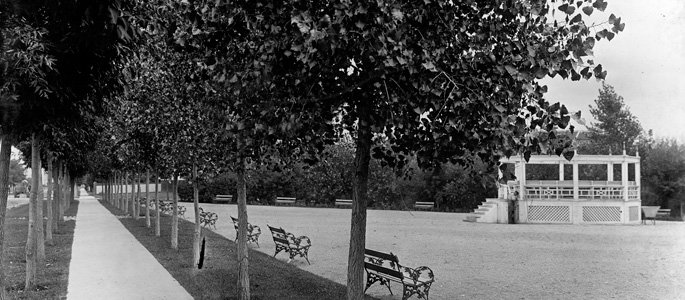
Stanley William McInnis arrived in Brandon in 1889 and set up practice as a dentist. By 1906, he was president of the Manitoba Dental Association as well as the first president of the Canadian Dental Association. McInnis was elected to the Manitoba Legislature in 1899, serving three consecutive terms. In June of 1907 he was appointed Provincial Secretary and Minister of Municipal Affairs. McInnis passed away suddenly of appendicitis November 4th of the same year. Mayor S.E. Clement declared November 7th a public holiday so that all would have the opportunity to attend the funeral. West End Park was renamed Stanley Park in his memory.
McClement, S.
In 1910, S. McClement built the duplexes at 247/251 16th Street for a cost of $3,000. The layout accommodated two families, but in more recent years it has been split into six or more apartments.
Maley, Henry Fitzgibbon
Henry Fitzgibbon Maley established the Brandon Brewing and Bottling Company in 1902, alongside his brother Edward Maley and Alexander Ferguson. Maley served as president of the company until 1917, when prohibition spelled the end of the brewing business. Maley also served as city alderman and as director of the Brandon Baseball Club. He and his family were the original owners of 1605 Victoria Avenue, which they had built by W.H. Shillinglaw in 1912.
MacDiarmid, Dr. Henry
Dr. Henry MacDiarmid purchased the Maley property in 1916, when Henry Fitzgibbon Maley lost his presidential position at the Brandon Brewing & Bottling Company when it was closed due to prohibition laws. The property remained in the MacDiarmid family for two generations.
McGregor, J.D.
The house at 324 13th Street was built for the honourable J.D. McGregor, an internationally known cattle breeder who later served as Lieutenant Governor of Manitoba from 1929 to 1935.
McKenzie, A.S.
A.S. McKenzie built the house at 318 11th Street in 1906 based on the design by Thomas Sullivan.
McDonald, John A.
John A. McDonald was one of Brandon's earliest pioneers. He came to Brandon in 1882, and worked for several people in town before entering into partnership with Frank Calvert in the men's furnishing business. In 1906, McDonald paid $6,000 for the house located at 318 11th Street.
Mutter, John
John Mutter lived in the house at 211 13th Street for over forty years. He was a partner in Mutter Brother's Grocery at 928 Rosser Ave. The house remains in the Mutter family.
McBurnie, John
John McBurnie was the first owner of the house at 262 13th Street. He was a gentleman lace merchant living in Montreal, and thus an absentee landlord.
McKenzie, A.E.
Francis Bethel McKenzie and bequeathed his seed buisness to his son, Albert (1870–1964), who renamed it A.E. McKenzie & Company in 1897. The Brandon business became the largest seed production and distribution business in Western Canada.
Matheson, J.S.
Dr. J. S. Matheson moved to Brandon with his family when he was ten years old. As an adult, he was known as "Tenth Street Central School's gift to medical practice". In 1898 he traveled to Bozeman, Montana and married. He was re-elected as the President of the City Football League in March of 1912. In 1916 he accepted an Imperial Government position. He died in 1942.
McKee, S.J.
S. J. McKee and his family first came to Brandon in November 1890, after teaching in Rapid City. He lost three daughters that winter to diptheria. In the following years, he established the S.J. McKee Academy at the Central School building. It eventually outgrew the facilities there and moved to the Flemming block. Soon after, control of the academy was given to the Manitoba Baptist convention, which renamed it Brandon College. In 1912, Brandon College awarded McKee an honourary law doctorate. He died in 1936.
McPhail, Alex
Alex was born and raised on his father’s farm near Brandon. He was a graduate of the Brandon College Institute, and served overseas with the Royal Flying Corps during World War II. After the war he returned to the family farm, which his father had established in 1881. He became known internationally as a breeder of Yorkshire swine. During his lifetime, McPhail served as president of the Provincial Exhibition Board, vice-president of the Winter Fair Board, director of the Manitoba Livestock Association, and as a member of the Brandon Wheat Kings executive board and the local Chamber of Commerce.
Muir, William
William Muir operated a grocery store on 6th street from 1888 to at least 1938. He died in 1946.
Meredith, Henry
Henry Meredith was born in Ireland in 1844. He immigrated to Canada in the 1870s and arrived in Brandon in 1883. He operated a general store in Brandon for ten years before establishing general agency and brokerage firm H. Meredith & Co. Meredith also served as director and, for two years, president of the Brandon General Hospital board. He owned over three thousand acres of farmland across western Manitoba and held stocks in various companies. Meredith passed away in 1917, leaving a $10,000 bequest to the YWCA for the construction of its new 11th Street building. In 2002, the building was renamed Meredith Place to commemorate its benefactor.
Marshall, William Richard
William Richard Marshall was a prominent Brandon architect during the city’s early days. Marshall was born in Scotland in 1854 before coming to Canada in 1879. He worked as an architect in Winnipeg before moving to Brandon in the late 1880s. Throughout his career, Marshall designed countless residential and commercial buildings. He quickly established himself as one of the city’s finest architects, designing such buildings as Brandon’s original City Hall, the Brandon General Hospital, and the Brandon Club.
Matheson, Robert M.
Robert M. Matheson was born in Woodstock, Ontario in 1868. He arrived in Brandon in 1884, where he established a successful law practice. In 1916, Matheson was honoured with an appointment to King’s Counsel. Later in his career, Matheson served as both city solicitor and crown prosecutor. In 1940, he was appointed city magistrate and juvenile court judge. He also served on the Brandon School Board. Matheson retired in 1944, one year prior to his death in 1945. Matheson is buried in the Brandon Cemetery.
McDiarmid, John S.
Former mayor John S. McDiarmid was one of Brandon’s earliest settlers. McDiarmid was a physician who practiced out of his home at 641 Lorne Avenue. McDiarmid was elected mayor four times: in 1892, 1894, 1899, and 1900. In later years, he served as president of the Brandon Liberal Association. He died in Brandon in 1936 and is commemorated by McDiarmid Drive.
Massin, Frank
Frank Massin was a successful businessman who dealt in hides and furs. Massin was born in Prague in 1866 and immigrated to Iowa where he entered the hide and fur business. Massin established his company in Brandon when he moved here in 1910. The warehouse stood at 333-339 Rosser Avenue. Thanks to Massin’s business, Brandon became one of the most important fur trade centres in the West. Massin's immense wealth and success allowed him to construct a handsome residence at 463-13th St. After Massin’s death in 1956, his son Francis C. Massin continued to operate the family company until 1964.
McMillan, Archibald L.
Brandon’s first chief of police was Archibald L. McMillan. McMillan served on police forces in Chatham, Guelph, and Winnipeg before being appointed Chief Constable to Brandon’s first police force in July 1882. At that time, the force only had three members. Chief McMillan served until his death in 1885. On December 16 of that year, McMillan was examining a rifle in Smart’s Hardware Store when the rifle was accidentally discharged, shooting him in the abdomen. McMillan left behind a widow and one child.
McLaren, Joseph
Born in Scotland, Joseph McLaren studied law and served in the Battalion of the Black Watch before moving to Brandon as a young man. He worked for the CPR and as a farm hand before deciding to pursue a career as a teacher. After finishing his education at the Normal School, McLaren became a physical education instructor. He also helped organize Brandon’s first Cadet and Girl Guides programs. McLaren joined the 12th Manitoba Dragoons, advancing to the rank of Major within three years. His battalion was one of the first to be sent overseas during the First World War. McLaren was killed in action at Ypres in April 1915, when the automobile he was in was hit by a shell. He was Brandon’s first citizen to be killed in WWI. He was commemorated by McLaren School, which was first located on 3rd Street. The second McLaren School was built in 1926 and now serves as the offices of the Brandon School Division.

Do you have any stories or comments to share about a heritage property in the City of Brandon? Click here to send your comments to Heritage Brandon.